Hope For The Community has partnered with @veritypcos to help those living with Polycystic Ovary Syndrome (PCOS) to manage their condition. The self-management courses launched in November 2022 and will be available until 2024.
This has been made possible with a grant from The Waterloo Foundation @Waterloo_TWF.
PCOS affects 1 in every 10 women, and those assigned female at birth, in the UK. There is no known cause or cure. The courses will help over 500 women in 2022, 2023 and 2024.
To sign up, please visit the Hope For The Community website http://h4c.org.uk/courses.
We hope to make more more spaces available as soon as our funding allows.
We co-developed and co-evaluated this course in partnership – with PCOS patients at the heart of the process throughout.
Psychologist Dr Carol Percy (a PCOS patient herself) led the co-creation of the course, which began with interviews with women who have PCOS, then input from Verity trustees and UK health professionals who specialise in treating PCOS. You can find out more about the co-creation process in this poster presented at the European Health Psychology Society conference in 2019. (Please click the image to access a pdf file copy from Open Science Framework).

The new course was evaluated by a group of volunteers all of whom had PCOS and participated in the pilot version of the course in 2019/20.
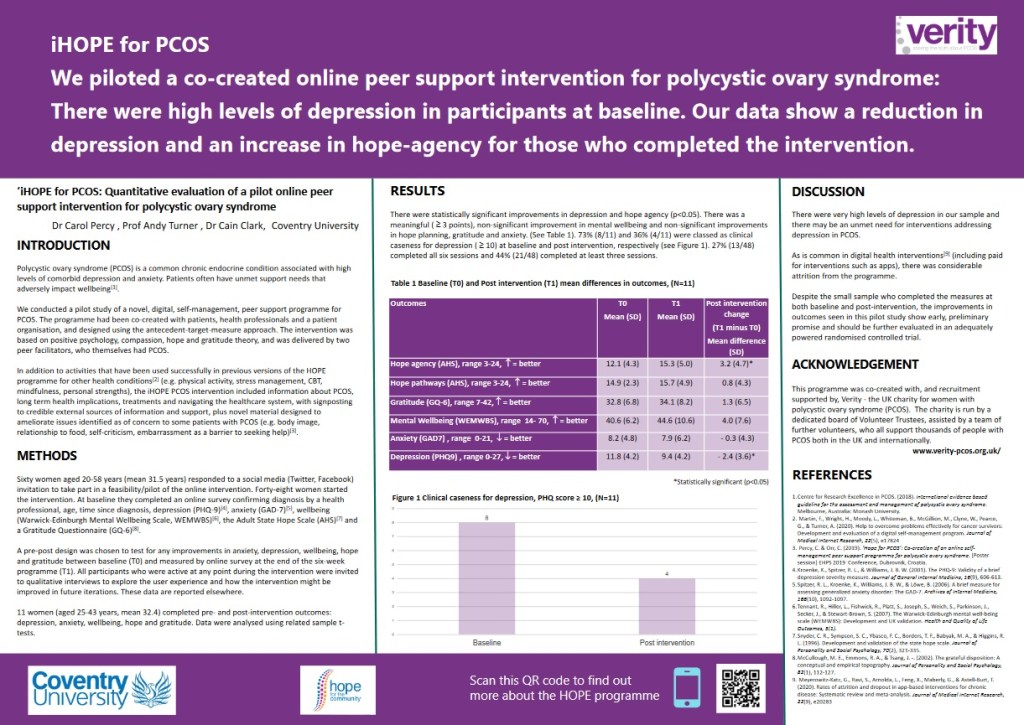
We collected quantitative data on a range of outcomes, including anxiety, depression, gratitude, hope and mental wellbeing, as well as interviewing course participants about their experiences of taking part. The results were very promising and we hope to conduct a feasibility randomised controlled trial in the near future.
You can see the quantitative results from the pilot study in this poster presented to the British Psychological Society Division of Health Psychology conference in 2021. (Please click the image to access a pdf file copy from Open Science Framework).
Participants’ experiences of the pilot course are described in this poster presented to the European Health Psychology Society conference in 2021. (Please click the image to access a pdf file copy from Open Science Framework).
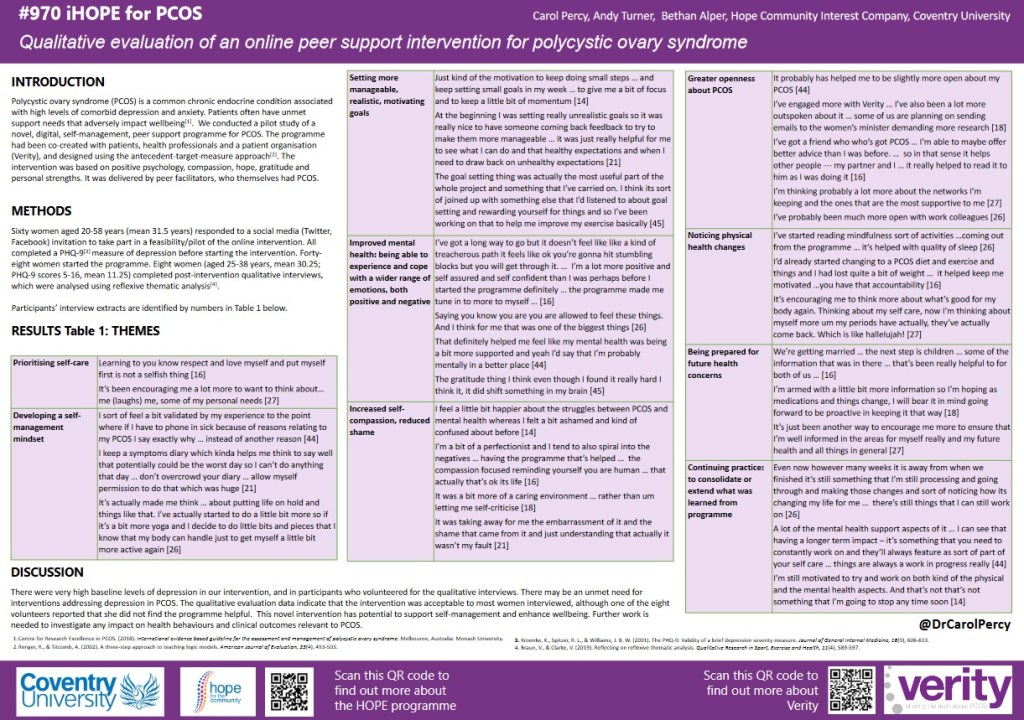
There is a brief video explanation of this poster available if you click here.
 Hope For PCOS